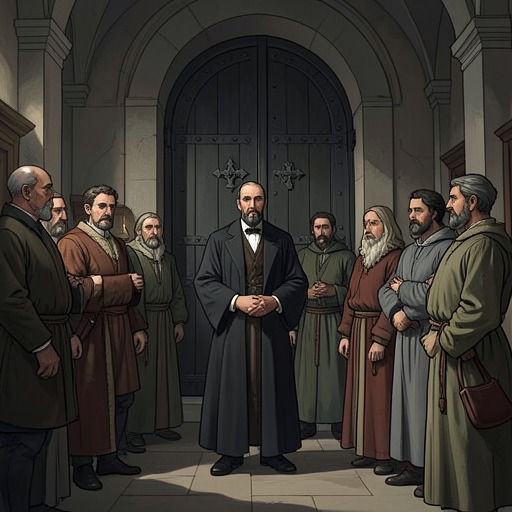
John Fisher
The King's CurseJohn Fisher is presented as a bishop whose religious authority is inseparable from personal loyalty and practical kindness. A childhood teacher and confessor to Margaret Pole, he later comforted her in widowhood, helped her approach Lady Margaret for aid, and found shelter for her and her children. By 1534, he was being held in the Tower with Thomas More, a measure of how far the world of his early pastoral service had shifted into political danger.
Identity and Early Relationship
Fisher was an old acquaintance of Margaret Pole and the confessor of the woman she calls My Lady. Their connection reached back to Margaret’s childhood at Middleham Castle, where Fisher taught the children their catechism and heard their confessions. He knew her brother, Edward Plantagenet, as a boy and as heir to the throne, and taught Margaret the psalms when her name was Margaret Plantagenet and she was the king’s niece.
When they meet again at Westminster after Margaret’s husband has died, Fisher recognizes the person she had been as well as the vulnerable widow she has become. He makes the sign of the cross over her head and bows as low as if she were still heiress to the royal house. The gesture contrasts with the household steward’s quick recognition of her diminished fortunes: Fisher’s courtesy preserves a memory of her former rank without ignoring her present loss.
Support for Margaret Pole
Margaret tells Fisher plainly that she has come for help. Her husband has left her with almost nothing, and she cannot manage on her dower rents. Fisher expresses sympathy and assures her that Lady Margaret will hear her kindly, since she would not neglect one of her family despite her many worries and responsibilities. When Margaret wonders how to plead her case, he does not leave her to approach the crowded court alone. He points her toward the open doors of the gallery and offers to go in with her, noting that many people are waiting to see Lady Margaret.
Fisher also brings Margaret news about her former charge, Katherine of Aragon: she is expected to return to Spain. Margaret is shocked, having thought Katherine was betrothed to marry the future king. In the subsequent private interview with Lady Margaret, the question of whether Katherine’s marriage to Prince Arthur had been consummated is framed as a legal matter bearing on the dispensation required for her proposed marriage. Fisher’s role in the account is to reconnect Margaret with the court and disclose the plan for Katherine’s departure; the pressure to give testimony comes from Lady Margaret.
A Refuge for the Family
Fisher’s assistance extends beyond advice and access. In response to Margaret’s appeal, he writes back at once and secures both a place for her and a refuge for Reginald. Margaret may live at Syon Abbey with her daughter and Baby Geoffrey. The community, led by a Mother Abbess and attended by about fifty nuns, sometimes receives noble visitors. For Margaret, the arrangement promises food and shelter; Ursula may later become a novice and enter the order, giving her a possible future there.
Fisher finds Reginald a place at Sheen Priory, the Carthusian house across the river from Syon. The two houses are only a few miles apart, and Margaret imagines that a candle in her window might let her son know she is thinking of him; a boatman might sometimes carry her to see him on feast days. Yet the refuge is also a separation. Sheen’s Carthusian discipline is exceptionally strict: its monks live and work alone, and speech is largely confined to Sundays and feast days, with a quiet communal walk once a week. Margaret fears that this silence is wrong for her bright, talkative boy, who loves reading aloud, singing rounds, and telling his brothers riddles and jokes. Fisher’s provision is generous in material terms, but the arrangement places mother and son in different religious houses and subjects Reginald to a life Margaret dreads for him.
Imprisonment and Narrative Significance
By summer 1534, Margaret is glad to be away from London, where Fisher and Thomas More are held in the Tower. Their imprisonment belongs to a wider crisis over the king’s authority in church and state. At Westminster that spring, the nobility is summoned before Thomas Cromwell to take the succession oath, while the Pope has publicly ruled that the marriage of Katherine and the king is valid. The narrative presents the competing claims of royal command, papal judgment, and individual conscience as increasingly difficult to reconcile; it does not detail Fisher’s own response to the oath in these passages.
Fisher’s appearances are brief, but they connect several forms of care and authority: childhood instruction, sacramental service, advocacy for a bereaved woman, and the finding of a home for children whose family has lost security. His careful recognition of Margaret’s former status is followed by tangible assistance, while his later confinement with More signals the narrowing space for trusted religious figures amid the king’s political transformation of the Church.